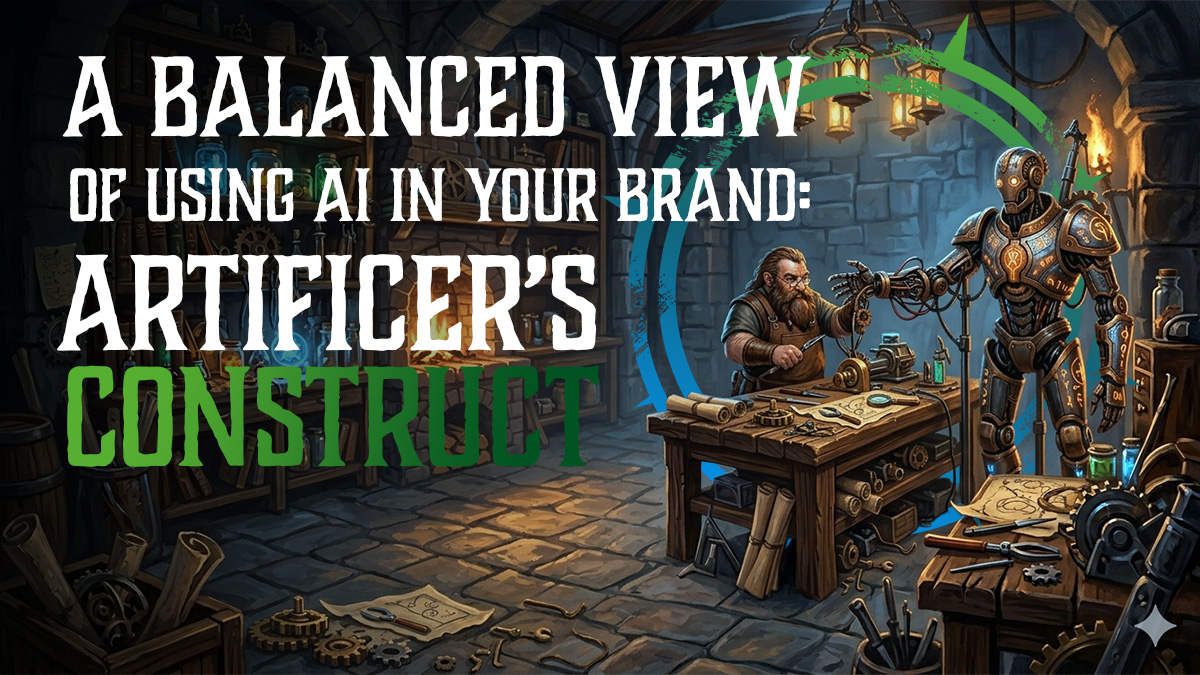
Do you know what an Artificer’s construct is? Probably not, but here’s the idea. It’s a mechanical servant, built by an artificer to complete rudimentary tasks efficiently. You build it, power it, and let it get to work.
It never tires, it never complains. It just works.
Sounds great, right?
Well, that’s AI.
On the surface, it sounds like a dream. An automaton, built specifically to make life easier for me? Where do I sign up.
But right now, so many business owners are handing over all of their brand to one. And frankly, you can tell. Logos, AI-generated. Website copy, AI-generated. Social posts, AI-generated. And don’t get me started on a ‘brand identity’ that’s been written in Chat GPT in about four minutes flat.
I understand why, though. It’s human nature to look for an easier way. And for small business owners especially, the allure of something that’s fast AND cheap is a siren song few can resist. Both those things matter when you’re bootstrapping a business.
The problem is, the construct has no idea what you’re fighting for.
What poorly used AI in your brand does
I’m going to start with this: I promised a balanced view, and I’m going to stick to that.
But to begin with, it’s important to understand the limitations of using AI in your brand. So let’s be honest for a moment and understand what AI is ACTUALLY producing when you ask it to build your brand.
AI Generates an Average
You’re not average, are you? No, you’re fantastic at what you do. And more unique than you probably think. So the problem with asking AI to distil that into a brand is that it generates based on an average of what’s out there.
It finds the middle and gives you what a brand in your sector typically looks like.
That’s less than ideal when the whole point of a brand identity (both strategically and visually) is to make you identifiable and different. If you want to look like everyone else, that’s brilliant! But I can guarantee that’s not what you really want, because it makes it hard for potential clients to remember you.
Social media is currently awash with posters for venues that are stylistically identical. You know the ones. Overstuffed images usually advertising bars and fairs, with rosy illustrations and no sense of white space. They all blend into one another.
If you start and end with AI, you will look nearly identical to everyone else doing so.
AI has no idea who you are
Oh, it can guess. But it’ll usually be sycophantic and tell you what it thinks you want to hear, based again on a generic average. Which makes sense when you think about it. Hell, you probably don’t know who you are, so how will AI?
So when we’re talking about who you are as a brand, we’re talking way more than a logo. This is the sum of your values, your story, your customers and your purpose. It’s even about who you won’t work with.
AI can’t see all of this. You can tell it, but then you’re doing most of the work anyway. Simply going into an AI chatbot and asking what YOUR values are will create what it THINKS someone in your industry wants to hear.
And again, this will be an average of everyone else, meaning you can’t possibly stand out.
AI produces without understanding
Your construct can forge you a sword, but what it can’t do is tell you what battles you’ll face or what enemies you’ll encounter. Is a sword even the right weapon? Is it well-balanced, or is it the right weight for you to wield?
When AI produces an output, it only does so with the understanding you give it. So if there are gaps in YOUR knowledge, those same gaps will become glaring omissions in the AI output.
Now, some AI models are better than others at asking questions, but one or two queries rarely give a full picture. A trained human will do a better job of noticing links and asking pertinent questions at just the right moment. And people are also better at noticing when an answer isn’t truthful, or hiding a deeper answer.
AI has a habit of taking your answers as gospel, even when you don’t realise they’re wrong. And if you start from the wrong place, is it any wonder you end up lost?
AI creates a brand that can’t withstand pressure
One of the main things people get wrong about ‘brand’ is thinking it’s purely visual. People often believe it’s only made by a stunning logo or bright colour palette. So when you start with ‘make me an amazing logo for x business’, all you’re getting is visuals with no context.
This holds together fine, until it doesn’t.
Your brand needs to withstand a lot of pressure. It needs to be visually distinct, tonally consistent, purposefully aligned and communicate effectively with your audience. When you build a brand in AI, you are going to miss things because you aren’t trained to know where the gaps are.
If you don’t know where the weakness is, AI won’t know either. That’s when cracks start to appear: the moment your brand needs to DO something. When it’s put to the test, the weak parts break.
And it can be hard to fix after the damage is done.
So AI is all bad for your brand, then?
As I said, I’m not here to tell you to throw out the construct. That’d be wasteful.
And I’m not big on waste.
Despite the issues above, AI does have some great uses for your branding efforts. Here are some excellent ways to use it.
AI helps with visual inspiration
Possibly the most difficult part of a project is the blank page at the beginning. I don’t know about you, but I used to agonise over the first mark I’d make on a page. A point of inspiration can help kick-start ideas, and AI can be very useful for that.
Understanding your visual territory helps you ‘see’ what you’re building, long before you make major decisions. As AI can help generate visual references, you can quickly use it to explore the look and feel of a brand before committing to any specific route. This can be particularly helpful to articulate feelings you’re struggling to name.
Using AI to build a digital moodboard is basically like reconnaissance. You’re scouting the area before you make firm steps that might be hard to change later.
AI helps speed up your research
When I talk to clients about their competitors, they sometimes say ‘I don’t have any – no one is doing what I’m doing.’
99% of the time, this is utterly incorrect. They’ve just not wanted to research beyond a cursory Google search.
Which I totally get. Research is not the most exciting part of branding. But it’s crucial.
Understanding your competitors, your market, and crucially, the language your ideal clients use, isn’t optional. It’s a vital component of understanding how your brand will be received and how it will fit into the business landscape.
AI shines here because it quickly helps you spot patterns, summarise results, and even spot market gaps.
Gathering intelligence helps your branding effort, as your decisions go from guesswork to strategic choices. And that makes your decision-making process much easier.
AI is a tool – not a replacement for humans
I mean, that’s the lesson of basically every sci-fi film, right? But as simple as the message sounds, it’s easily forgotten when you’re all excited about possibilities.
But without skilled input, that tool won’t give you a useful output.
AI is only really doing what you tell it to. It’s working within the parameters that you set. And if YOU don’t have the necessary understanding, the results won’t be as useful as you may hope.
And that’s not a dig. Knowing where your expertise is lacking is a huge skill in itself.
So when we look at using AI for branding tasks, it’s useful to remember that neither you nor it is an expert in branding. And here’s what an expert brings to the table.
A branding expert knows what questions to ask
Why does this matter to your clients specifically? What difference do you really create in their lives? How do you want a client to react to your brand?
These questions (and thousands more) are what shape your brand, and AI doesn’t know when and how to ask them. Some models are better than others, and may put a few questions to you before answering, but they can’t react and probe in the same way a human does.
Without human exploration, your brand ends up exactly the same as others because it only reflects the surface, not the deeper truths.
A branding expert makes decisions based on craft, not probability
Great designers aren’t looking for an average. They’re hunting for what makes you unique. Something specific and deliberately different. Where an AI bases a visual identity on an amalgamation of existing brands, a human designer creates an identity to fit.
And that has a huge benefit to your confidence.
Armour crafted to fit the warrior will always perform better than a chainmail shirt pulled from a pile. And in the same way, if your brand is crafted to fit you, you’ll immediately feel more confident. That confidence will get you more sales.
A branding expert knows how to hold everything together.
AI is pretty good at individual answers, but can’t put everything together for you. Professional brands are systems that work cohesively. They aren’t a bunch of random assets held together with tape and hope. Values, visuals, tone, customer journey and more need to align and work together to create the overall experience.
AI is able to assist this process, but cannot lead it.
Becoming a responsible construct handler
AI is most likely not going anywhere. Becoming familiar with it will be a massive boost for your brand. But it’s important to use it well rather than as the default.
And the biggest question to ask yourself is this: ‘Is the AI helping me think, or thinking for me?’
Take a simple example that every business owner knows – the logo. If you use AI to create mood boards to show a designer what you and your audience are drawn to, that’s good. If you use it to create a final logo because a designer ‘feels expensive’, that’s letting the AI create above its station.
That’s letting the AI do the thinking, and it won’t do you any favours in the long run.
Another example: your brand values. These need to perform several roles (and here’s a handy guide to how to write good ones), while being different from your competitor’s. So, using AI to research how your competitors position themselves is good. Using it to write your brand values, as you’re not sure what they are, basically outsources your identity to a machine that doesn’t know you or your customers.
As a simple rule, AI belongs in the early, ideation stages of the process to support your work. It doesn’t belong where decisions are made.
When you reach the stage where you’re making real decisions about your brand identity, that’s when you need a real expert alongside you.
Because AI is useful, but your brand deserves to be more than the average of everything else.
The construct is a useful servant, but it’s a poor master. So build your brand accordingly. One way to do that is to understand its core better. I’ve developed a short guidebook that you can download for free – just click the link below.