Recently, I had to deal with a toxic element that threatened the harmony of a small, local business community.
Now, their exact actions aren’t worth unpacking here (but for the curious among you, the shortlist was bullying, misogyny and bigotry), but even after their removal, the effects were still felt. And that got me thinking about how toxic elements can slowly seep into a brand unnoticed.
And that insidious nature does long-term damage.
Think of being in battle, and your opponent has coated their blade in a slow-acting poison. You might be the better fighter and come out on top, but that tiny cut they delivered lets the venom in. And it slowly goes to work destroying you.
That’s what toxic elements are doing to your brand. At first, they look harmless enough. Ignorable, even. ‘This client seems fine’ or ‘This shortcut seems harmless’. But every time you let it slide, your brand’s integrity is being eroded.
Until eventually, there’s nothing left.
So, in this article, we’ll cover some of the most common sources of toxicity in a brand, how to recognise them and how to build your defences so they can’t damage your hard work.
Identifying Elements that are Toxic to your Brand
When we cure a poison in roleplay, we first need to identify it. You can’t cure everything the same way, so knowledge comes before both prevention and cure.
In the same way, identifying where the most likely sources of toxicity come from can help prevent them from infecting your business. Here are four of the most prominent sources.
Bad Clients
Let me guess. You’ve had at least one.
I certainly have.
The client who haggles over every invoice or rewrites the brief six times and still insists you got it wrong. And don’t get me started on the people who use AI to send you a long list of revisions that are senseless at best, or self-defeating at worst. Or the passive-aggressive review, because you wouldn’t provide unlimited free changes.
These are damaging to your brand. Let alone how fucking annoying they are.
Every client you serve becomes part of your story. And if half of them are difficult, how do you think your story will read? No, not like a hero overcoming adversity. It’ll read like you’re slowly drowning.
When you take on nightmare clients because you need money, you damage your reputation. You train the market to expect that version of you. You attract more of the same because you signal that your standards are negotiable.
Showing you’ll absorb bad behaviour for cash is the best way to burn yourself out.
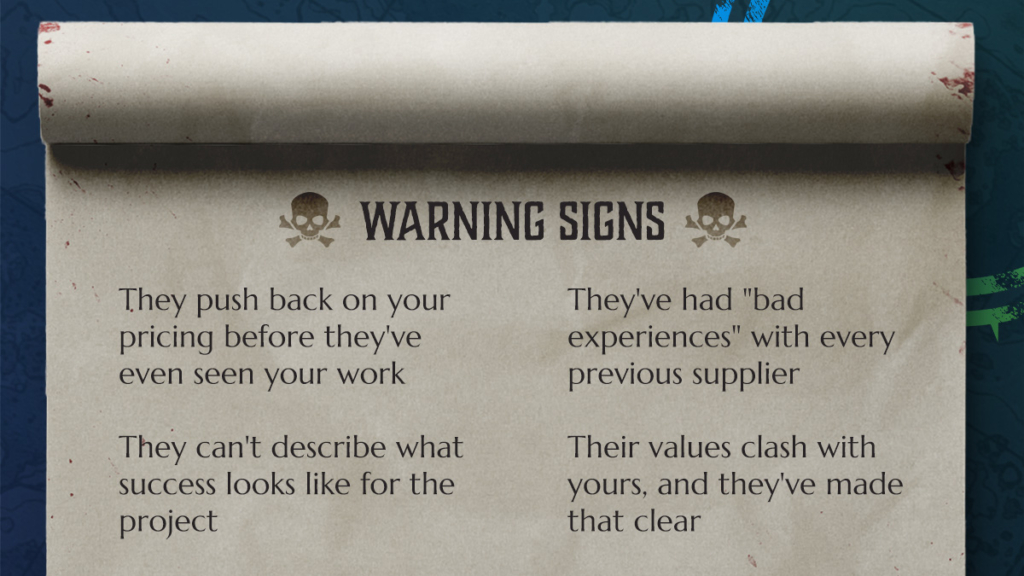
Here are some warning signs to look out for:
Unhealthy Partnerships
Partnerships are, in theory, excellent for your brand. Delivering more than you can alone is a force multiplier. Combined strength through collaboration can land both parties much larger clients than they could deal with alone.
Collaboration absolutely works to grow your business. That is, until you realise both parties are moving in different directions.
Misaligned partnerships are worse than not having one. When you associate your brand with someone else’s, you invite your audience (and theirs) to view you through the same lens. Basically, by aligning yourself with a partner, their reputation becomes yours, and vice versa.
The differences come out eventually. And the fallout lands on BOTH of you.
I’m not trying to frighten you out of building relationships. I love community. I’m in this one, this one, this one and more. But you must build partnerships with businesses that align with your values.
Otherwise, you’ll just take on their shit, too.
Bigotries and Discrimination
I don’t need to tread lightly with this one.
If your brand tolerates bias, exclusion or discrimination, you’re doing far more than just being morally wrong. You’re building your foundations on sand.
(And if you’re actively reflecting those things, you can leave right now).
Audiences pay more attention than you give them credit for. They remember things and inform others. And the long-term consequences of building an exclusionary brand are less than subtle.
Clients, staff and partners leave and will be sure to let people know why. This absolutely demolishes brand perception and can have devastating effects on your business.
And yes, I know you’re not meant to appeal to everyone. But you can niche down without actively being a dick.
The Impostor Within
It’s important to note that toxic elements can come from anywhere. Even from your own limiting beliefs.
Yes, your own mind might be poisoning your brand!
Imposter syndrome can really do a number on an otherwise excellent brand. When you lack confidence, prospects start to see cracks in something they might have been ready to buy. It stops you from charging your value and makes you second-guess every message you put out there. Indecision prevents your brand from being clear, and that creates longer lead times and lower conversion.
And all of that is exhausting.
Being confident in what you do and that it will really help your clients is vital for a strong brand.
What Toxic Elements do to your Brand
Posion is patient. It doesn’t usually damage your brand instantly. Instead, it erodes it from the inside, building up until it becomes almost impossible to fix.
Damage to Brand Reputation
Trust is difficult to build, but almost laughably easy to destroy. All it takes is one viral complaint from a bad client, or a screenshot of an off-colour comment, to break a reputation.
Your audience has a long memory. Dismissing small things as ‘a one-off’ leads to the issue continually rearing its head. If you don’t deal with these things early, you’ll be explaining them for years.
Reputational damage can be hard to fix, as once it’s out there, changing perceptions back is a MUCH taller order than getting them on board in the first place.
Financial Implications
You only have so much capacity, so don’t waste it on people who don’t respect you or your craft. Bad clients take up space you could have used for good clients. And a well-fitting client will do more for the longevity of your brand than a single paycheck.
Every extra hour you spend trying to make a bad client happy is an hour taken from somewhere else in your business. And the worst part is, you can’t win. Either they’re never happy and leave unsatisfied, or you bend over backwards to make them happy, and they bring more people like them.
And when that happens, you get stuck in a perpetual cycle of clients who don’t respect your time and won’t pay what you’re worth. Which means zero time for good clients who would actually grow your business.
Plus, once this damage is done, it costs to fix. Both money and energy. It’s hard to tell a new story when the old one keeps cropping up.
Internal Damage
When you overlook these problems, they damage the heart of your brand. Your systems and foundations can seem impervious, but they’re most vulnerable to internal threats.
If you allow your brand values to slip, your standards start to go too. When they do, it makes it easier for people to exploit your boundaries. And that prevents you from thinking the brand is something worth fighting for.
Your actions show what you’ll put up with. Every time you drop your integrity, you lower the bar for what you’ll tolerate. Eventually, your brand becomes a free-for-all, and you lose every shred of unique identity you ever had.
This is even worse if you have a team, as it can infect the culture and change it from a welcoming environment to one where only the worst impulses thrive.
Building Resistance to Toxic Elements
Potentially toxic elements can damage your brand. However, it’s nearly impossible to avoid them entirely when you’re in business. But you CAN build strategies and systems that make you more resistant to them.
And you absolutely should.
Not only do the following strategies make your business more resilient, but they also make your brand more attractive. Which is kind of the whole point of branding. The more attractive you can make it to your ideal clients and partners, the easier it is to say ‘no’ to potentially harmful ones.
Define your Brand values, and don’t be afraid to use them
Your brand values are not a list of nice-sounding words that you look at once and then ignore.
Especially if you’d betray them for a quick payday.
Your values only work if you’re using them to aid your decision-making. Both big AND small. When you can feel a red flag being raised, that’s your values yelling at you to pay attention. The client who is ‘probably okay’, or brushing off a derogatory statement from a networker as ‘just a bad joke’. If you start letting things slide, you’re allowing worse to come in the future.
Your values should help you make decisions under pressure. If not, they’re just decoration.
Unfortunately, most brands fall at this stage. Which actually leaves you with an opportunity. If you have strong values that you stick to, you’re sending a powerful message that few other businesses manage.
Screening clients and brand partners
You know you’re allowed to choose who you work with as much as they choose you, right? In some ways, that’s half the point of running your own business.
Build a vetting process before onboarding. A system helps you notice red flags early and avoid embarrassing situations where you’re onboarding or already working with someone when you notice problems. Pay attention to what they’re telling you and what they’re coy about.
And be prepared to lay down your expectations early. I can’t count how many times I’ve mentioned a deposit early on, only to avoid a ‘client’ who obviously had no intention of paying.
It’s vital to do your homework for partnerships. Asking around about them is due diligence, and not rude. Ensure your values align in practice, and be honest with yourself if you don’t feel you match.
Build an actively inclusive brand
While it is important to niche, that doesn’t mean you should build your brand to be spiteful. I KNOW my brand puts some people off, but that’s down to taste, not immutable characteristics.
Make deliberate choices that signal you’re welcoming and engaged, in your imagery and your language.
Remember that when you engage in communities, you need to listen more than you broadcast. Hear what people are saying, and you’ll get clues on how to keep your brand engaging and inclusive. And when you do something wrong (because we all f*ck up on occasion), own it and show how you’re fixing it.
Basically, your brand shouldn’t treat inclusion as a campaign.
Conclusion – Keeping your brand toxic-free
A strong brand is hard to build. Toxic brand elements can seriously damage your reputation if you let them, destroying all that hard work.
But that’s where the important point is. IF you let them.
Vigilance is key when combating elements that can damage your brand, so being aware and acting on red flags early is crucial. Toxic elements don’t (usually) announce themselves loudly; they’re much more insidious.
The worst thing you can do is to let things slide. That lowers your boundaries and makes it more likely that you’ll let worse slide next time.
It’s also important not to get paralysed by fear of what might happen. Inaction is its own special kind of poison, so being aware but not terrified is important. So long as you are vigilant, your gut usually warns you of threats.
The good news is, you have more control than you think. Your values are a screening process, so use them to ensure you don’t let poison seep in.
A poisoned blade doesn’t care how good the warrior is. It works the same on everyone.
Your brand is worth defending, but only if you know what you’re defending it from.
Not sure your values are doing their job? That’s worth a conversation. Get in touch and let’s find out what’s letting the poison in.
Before it does any more damage.